Group exhibition "Colour as Message. Colour Photography Before the Digital and AI Era", RPB 2026
Opening hours
26.05-30.05
Tu-S: 12-18
Location
Galerija "Istaba", Krišjāņa Barona iela 31B, Rīga
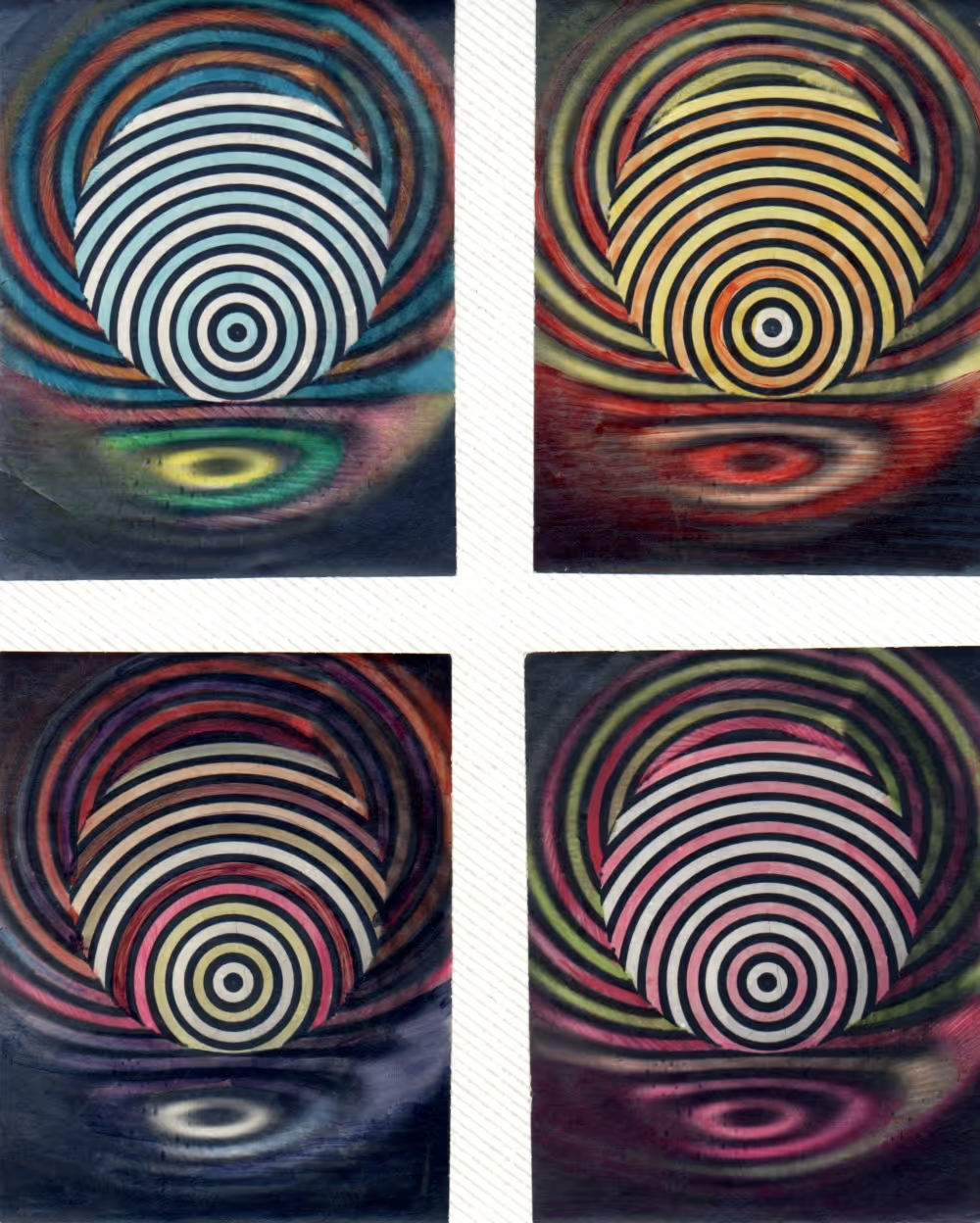
We live in a colourful world, and one of the problems faced in the early days of photography was the inability to capture the surrounding reality in equivalent amounts of colour. Hence, the colourising of photographs by hand – in order to achieve greater verisimilitude or give the image a particular artistic quality – appeared almost at the same time as the discovery of the photographic process. These manipulations by hand were usually carried out by artists or photographers who had received an artistic education. Thus, each photograph acquired the status of a unique image, similar to that possessed by painted works of art. Yet in many cases much broader and, from a documentary perspective, seemingly more precise possibilities were also developed to augment or "enhance" reality, thus reducing or even eliminating all those visual imperfections present in a specific person or an actual place.
The golden age of hand-colourised photographs is considered to be the period from the late 19th century to the middle of the 20th century, after which colour photography came into widespread use. But the interest in colourising images by hand survived in a different milieu even after that. It drew the attention of many artists internationally, as well as in Latvia, providing another opportunity to realise their creative ideas. Often colour became a means to express a protest against popular taste or the political situation, or to give an image an unreal mood. These were essentially also manipulations of reality, but with a conceptual purpose.
Digital image processing and the use of AI in the processing of photographic images open up unlimited possibilities for manipulating reality and further highlights the question of credibility, especially when historical photographs are subjected to "enhancements". New technology brings new opportunities but also increases the risks. Today, image processing is available to not only professionals but almost anyone who knows how to use technical devices and new technologies. Consequently, it is really intriguing to take a look back into the past and learn about the origin and development of this process, from when artists started to manipulate photographic images to render reality in full colour right up until the moment when colour became the message.
The exhibition will present hand-coloured photographs by unknown artists dating from the mid-19th century onwards and held in several private collections, as well as colour photographs by the contemporary Latvian artists Kristīne Luīze Avotiņa, Artūrs Bērziņš, Valdis Celms, Lilija Dinere and Atis Ieviņš, all of which are courtesy of their authors.
Participants: Kristīne Luīze Avotiņa (LV), Artūrs Bērziņš (LV), Valdis Celms (LV), Lilija Dinere (LV), Atis Ieviņš (LV)
Curator and text author: Irēna Bužinska (LV)
Exhibition design: Ineta Sipunova (LV)
Image: Valdis Celms, from the series 'In the Space Beyond', 1969–1970, Silver gelatin print, felt-tip pen, Property of the author
About the Riga Photography Biennial
The Riga Photography Biennial is an international contemporary art event that focuses on the analysis and artistic representation of visual culture. In the title of the Biennial, photography is used as an umbrella term for a wide variety of artistic practices in image-making that continue to transform the language of contemporary art in the 21st century. The biennial’s themes range from cultural theory to current sociopolitical processes in the Baltic and European regions. The Riga Photography Biennial aims to capture and, in the format of an art festival, offer a shared understanding of the changes taking place in the world—changes that we need not only to see but also to imagine, translating today’s complex and saturated visual language into meaningful relationships—between everyday life, the camera lens, historical material, contemporary art, technology, and the future. How has the understanding of photography and the image changed due to digital technology, and how does it manifest itself within the context of a work of art? For the organizers of the Biennial, these are crucial issues to analyze and represent, offering Latvian audiences the most relevant examples of international art through exhibition displays, as well as introducing the ideas of prominent art theorists through symposia, discussions, and publications within the formats of exhibitions and performances. The first Riga Photography Biennial took place in 2016. The Riga Photography Biennial 2026 runs from April 16 to July 3 with an extensive exhibition and educational program, marking the RFB’s ten-year journey. For more information:
www.rpbiennial.com.
.webp)
.avif)
.jpg)
.avif)
%20(2).avif)